

Judicial Officers
Judges and magistrates review ERPO petitions, consider the evidence, and determine whether an ERPO is necessary. This section provides an overview of Extreme Risk Protection Orders, what the filing process is (including the statutory requirements for ERPOs), what respondents’ rights are, as well as model policies, best practices, training videos, and more for judicial officers.
What is an ERPO?

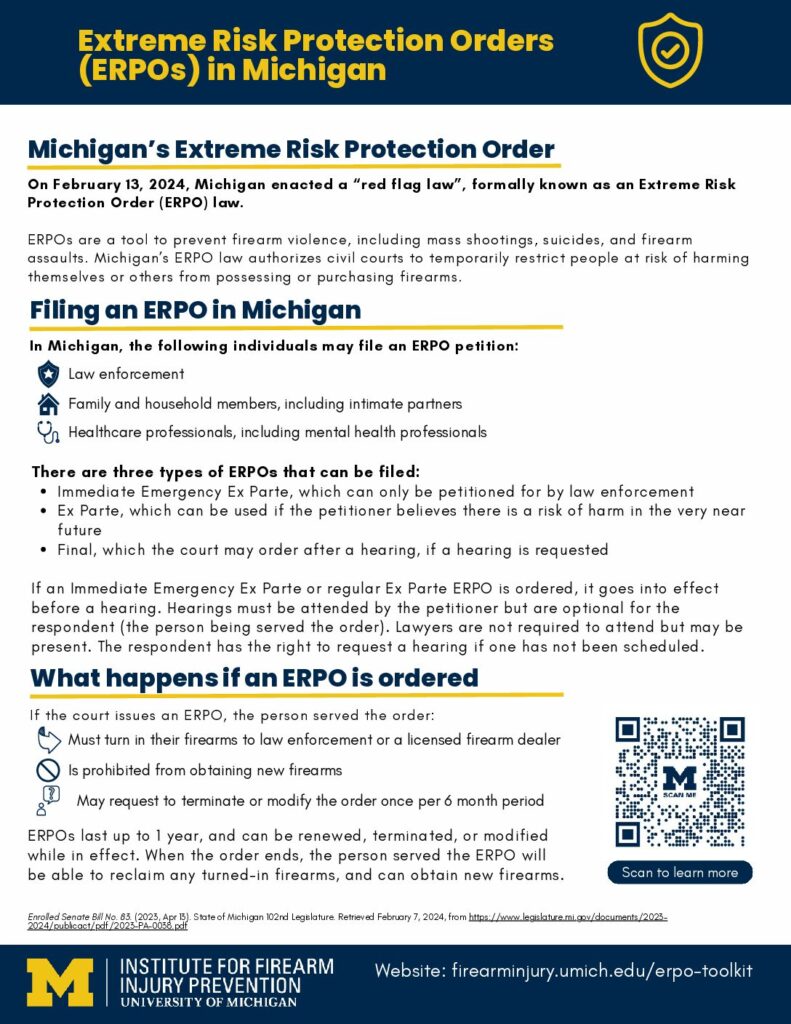
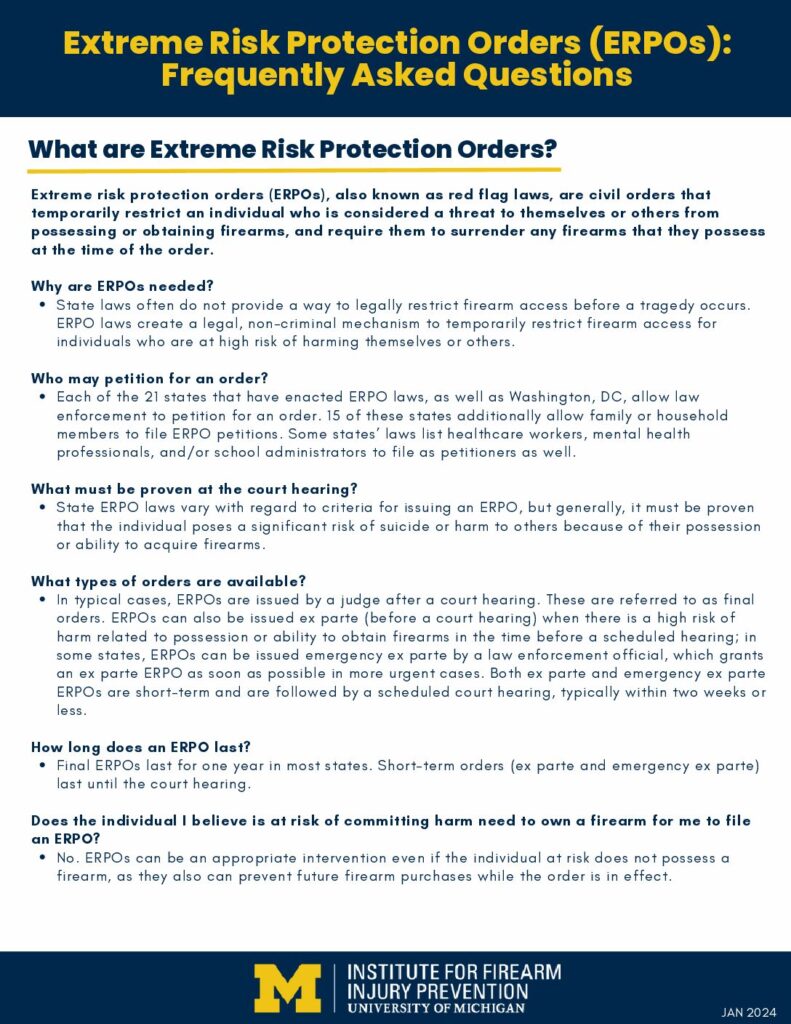
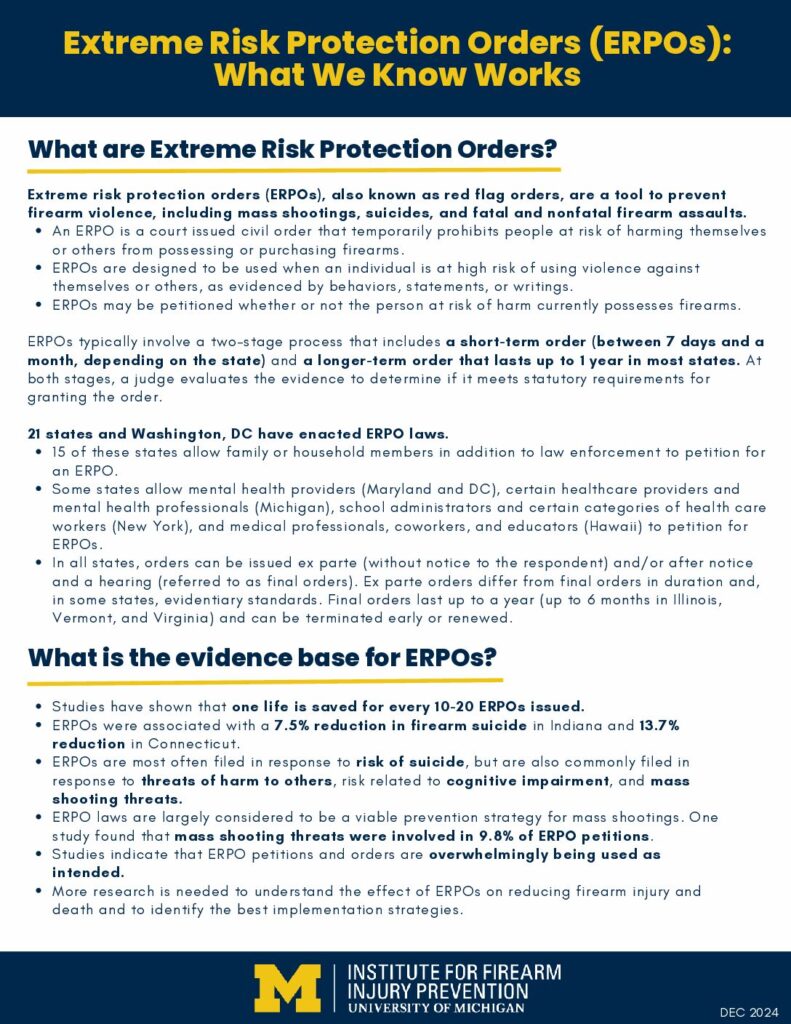
On February 13, 2024, Michigan enacted a “red flag law”, formally known as an Extreme Risk Protection Order (ERPO) law. ERPO laws authorize civil courts to temporarily restrict people at risk of harming themselves or others from possessing or purchasing firearms. In Michigan, law enforcement, families and household members, and healthcare providers can file an ERPO petition. In this section, learn more about Michigan’s ERPO law, who can file an ERPO petition, and what happens when an ERPO is filed in the Great Lakes State. If you are in immediate danger, call 911. If you are experiencing a crisis, call or text 988.
Learn More about Michigan’s Extreme Risk Protection Order
Filing an ERPO in Michigan
In Michigan, the Extreme Risk Protection Order (ERPO) law allows law enforcement, families and household members, and healthcare providers to file an ERPO petition. In this section, learn about the ERPO filing process in Michigan, from accessing and submitting court forms to the hearing process, as well as what options are available after an ERPO is ordered. If you are in immediate danger, call 911. If you are experiencing a crisis, call or text 988.
An ERPO petition in Michigan is called a complaint. The person filing an ERPO complaint, referred to as the petitioner, must fill out the relevant complaint forms and submit them to the family division of the circuit court. The complaint should describe the specific facts that show someone, known as the respondent, is at a significant risk of harming themselves or others. The respondent does not need to currently be in possession of a firearm for the petitioner to file an ERPO complaint.
If the petitioner believes the respondent is at risk of harming themselves or others in the very near future, the petitioner may indicate on the complaint form that they are requesting an ex parte order. An ex parte ERPO complaint will receive priority from the court to review, and will be decided without a hearing. If filing an ex parte complaint, the petitioner must detail why they feel an ex parte order is appropriate.
The petitioner must state, if known, whether there are currently any other legal actions, orders, or judgements, including another ERPO complaint or order, affecting the respondent. The petitioner must also state, if known, whether the respondent is a member of law enforcement or otherwise required to carry a firearm for their occupation.
The court will determine, based on the information detailed in the complaint and by the petitioner’s and respondent’s testimonies (if there is a hearing), whether an ERPO is necessary. The factors that the court may consider include, but are not limited to:
- Use of physical force or violence
- Prior or current legal injunctive orders
- ERPO or Personal Protection Order violations
- Criminal offences
- Alcohol or controlled substance abuse
- Unlawful use of deadly weapons or ammunition
- Serious mental illness or emotional disturbance
The following forms are used to begin the ERPO petition process:
If the respondent is an adult, use Form CC 452.
If the respondent is a minor, use Form CC 452m.
All complaints must include a Confidential Information Form, Form CC 450, which records the petitioner’s address. This form is kept confidential by the court. *Please note: this form only keeps the petitioner’s address confidential. Other information about the petitioner might not be kept confidential.
If the petitioner is a minor or legally incompetent/incapacitated, a Request for Next Friend and Order Form, Form CC 465, must be filled out. The Next Friend will take the responsibility of the complaint on behalf of the petitioner.
ERPO complaints must be filed to the family division of the circuit court. Circuit court jurisdictions are typically, but not always, along county borders.
- If the respondent is an adult, the petitioner can file the complaint in any county in Michigan, regardless of where the respondent or petitioner reside.
- If the respondent is a minor, the complaint must be filed in either the petitioner’s or the respondent’s county of residence.
- If the respondent does not reside in Michigan, the petitioner must file in their own county of residence.
If the ERPO petition does not indicate that an ex parte ERPO is requested, a hearing will be scheduled within 14 days for the court to determine if an ERPO is necessary. It is required for ERPO petitioners to attend a hearing with the court to review the complaint and the evidence for why an ERPO may be necessary. If the petitioner does not attend, the ERPO will be not be granted. When the petitioner requests a hearing (meaning they do not request an ex parte ERPO), the petitioner is responsible for providing a copy of the complaint and notice of the hearing to the respondent. If the respondent is a minor, the petitioner is responsible for serving the respondent’s parent(s) or legal guardian(s). The respondent is not required to attend the hearing. Both the petitioner and the respondent may have lawyers present, but this is not required. If requested, the court may allow the hearing to be conducted via videoconferencing.
If a complaint is filed ex parte, the court will decide on issuing the ERPO without a hearing. If an ex parte request is rejected by the court, the petitioner can still request a hearing within 21 days of the denial. That hearing would be scheduled within 14 days of the request. If an ex parte ERPO is ordered, the respondent will have the opportunity to request a hearing within 7 days of receiving the order, and the hearing will be scheduled within 14 days of the request.
*Please note: A hearing would be scheduled within 5 days if the respondent is a member of law enforcement or otherwise is required to carry a firearm for their occupation.
The court will decide whether to grant or deny an ERPO, based on the evidence, and will provide a written justification for their decision.
If an ERPO is granted, unless otherwise specified by the court, the petitioner is responsible for serving the order to the respondent and returning the proof of service document attached to the order back to the court. The respondent must turn in all of their firearms to law enforcement if they had any in their possession. If allowed by the court, the respondent may turn in their firearms to a licensed firearm dealer instead.
The court may specify that firearms must be turned in immediately, in which case a member of law enforcement will serve the ERPO to the respondent. In this case, the court may also grant an anticipatory search warrant to the law enforcement officer to search the respondent’s property for any firearms if the respondent refuses to comply with the order.
An ERPO in Michigan will last up to one year, during which the respondent is prohibited from possessing or purchasing firearms. If the respondent does not follow the order, they may face penalties such as fines or even jailtime. The petitioner may request to modify or rescind the ERPO at any point during the duration of the order. The respondent has the right to appeal to modify or end the order once per six month period of the order. At the end of the order, the petitioner or the court may motion to extend the order.
Petitioners and respondents may both use the Motion to Modify, Extend, or Terminate Order Form, Form CC 460, to request the court to change the ERPO. A hearing will be scheduled 14 days after the motion is submitted. Whoever submits the motion must notify the other party of the hearing.
When the ERPO ends, unless prohibited for another reason from possessing firearms, the court will order that the respondent will be allowed to possess and purchase firearms once again, and may reclaim any firearms turned into law enforcement or a licensed firearm dealer. The respondent has 90 days to reclaim any firearms; after 90 days, law enforcement may destroy the firearms if they are not reclaimed.
Please note: filing a complaint as a petitioner means you may be responsible for informing the respondent of the ERPO hearing as well as be responsible for serving the ERPO to the respondent. While petitioner addresses are kept confidential by the court, other personal information may not be. The petitioner’s identity will be known to the respondent.
If you are unsure, unable, or uncomfortable to serve as the petitioner, but still believe you need to file an ERPO complaint, contact your local law enforcement and request that they file an ERPO complaint on your behalf.
Not in Michigan?
see how to file an ERPO in your stateFrequently Asked Questions for Those Served an ERPO
If you’ve been served an extreme risk protection order (ERPO), you are considered the respondent to the order. Please read the service papers carefully and make sure you follow all of the instructions in the order. This section answers common questions surrounding being served an ERPO in Michigan, what steps need to be taken as the respondent, and what options are available for respondents.
ERPO laws authorize civil courts to temporarily prevent people at risk of harming themselves or others from possessing or purchasing firearms. In Michigan, the ERPO law allows law enforcement, families and household members, and healthcare providers to file an ERPO complaint.
An ERPO lasts for one year, but it may be extended one or more times by either the petitioner or the court, with each extension effective for one year after the expiration of the previous order. ERPOs can also be modified or terminated by the petitioner at any time. You will be given written notice if a hearing is scheduled on whether the ERPO might be extended, modified, or terminated. You can also ask the court to end the ERPO early through filing a Motion to Modify, Terminate, or Extend the ERPO, Form CC 460.
If the court issues an ERPO ex parte (without a hearing that you had the opportunity to attend), you will have to comply with the order. You have the right to request a hearing within 7 days of being served, and the hearing will be held no later than 14 days after you receive notice of or are served with the ERPO. If your job requires you to carry a pistol, you can request a hearing to be held no later than 5 days after you receive notice of or are served with the ERPO.
If you were served an ERPO ex parte, you have the right to request a hearing. If a hearing has been requested by the person who petitioned for the ERPO, you will receive notice of a hearing in which the court will decide whether to grant or deny the ERPO, to be held within 14 days of the petition (complaint) being filed. You will have the opportunity to be heard at the hearing if you would like to present any concerns or objections that you have about the order. If you request a hearing, you must attend for your case to be heard. Although not required, you have the right to seek the advice of an attorney.
Please read the service papers carefully and make sure you follow all of the instructions in the order. If you are served with an ERPO, you will need to turn in any firearms you own to the law enforcement or, if allowed by the court, to a licensed firearm dealer. If you have a concealed pistol license, you must turn it in to the county clerk. You must file with the court any documents or other evidence verifying that you turned in all the firearms that you own and your concealed pistol license, if applicable. If you do not own any firearms, you must file documents or evidence verifying that, instead. For the duration of the order, you will not be able to obtain any new firearms.
If you don’t follow the instructions of the service papers, the court clerk will inform the local law enforcement agency, which will try to determine if you have held onto any firearms or a concealed pistol license. The court will schedule a compliance hearing to be held no later than 5 days after the ERPO is served, which can be canceled if you submit the required documentation before the hearing. If you neither submit the required documentation nor appear at the compliance hearing, the court will issue a bench warrant and a search warrant to seize any firearms, and you may be held in contempt. It is a felony offense not to comply with an ERPO, punishable by prison time and/or a fine.
Yes. You can file a motion to modify or end the order and request a hearing once during the first six months that the order is in effect and once during the second six months. At the hearing, you can provide evidence for why the ERPO is no longer necessary.
When the ERPO ends, unless prohibited for another reason from possessing firearms, the court will order that you will be allowed to possess and purchase firearms once again, and may reclaim any firearms turned into law enforcement or a licensed firearm dealer. You will have 90 days to reclaim any firearms turned in to law enforcement; after 90 days, law enforcement may destroy the firearms if they are not reclaimed.
ERPO case files are public record. This may include phone and email information of the parties listed in the record. However, ERPO case files do not disclose the petitioner’s address and courts are discouraged by the Michigan State Court Administrative Office from publishing case information online.
ERPO for Judicial Officers
These resources are available to judges, magistrates, clerks, and other judicial officers who may be receiving, reviewing, and ruling on ERPOs in Michigan.