

Family and Household Members
In Michigan, Household and family members, including intimate partners, can file for an ERPO if a loved one is at risk of harming themselves or others. Additionally, secure firearm storage is required by Michigan law if children are, or are likely to be, in the home. In this section, find resources for parents and other family members for best firearm storage practices.
What is an ERPO?

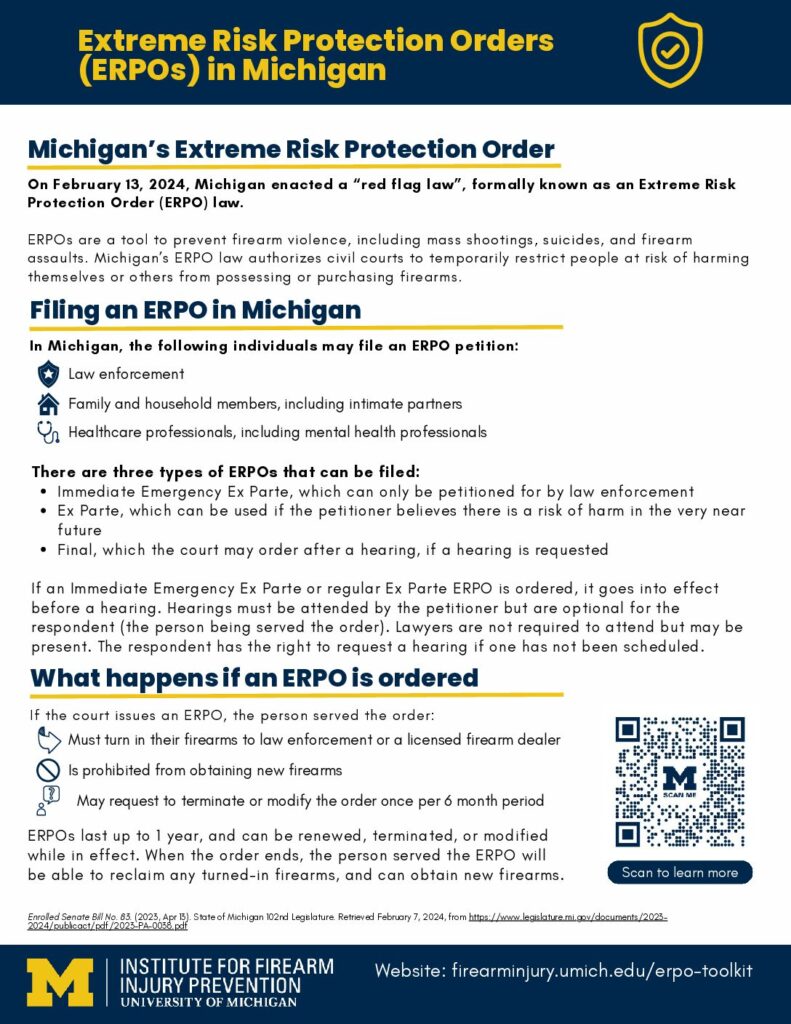
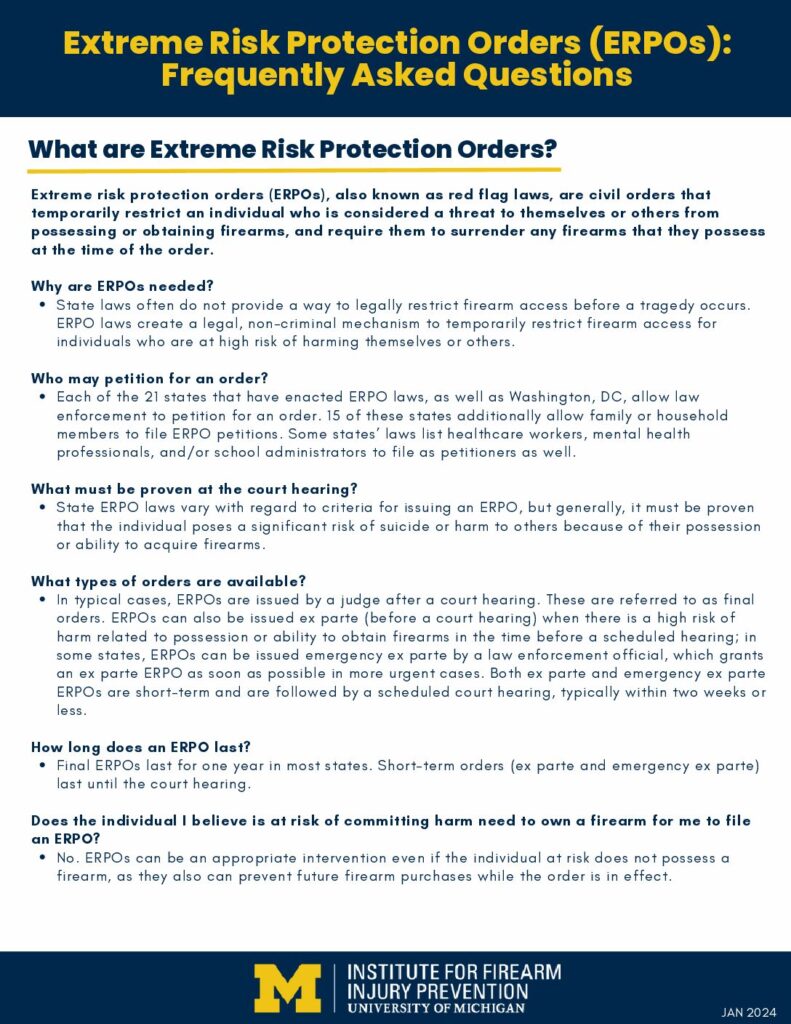
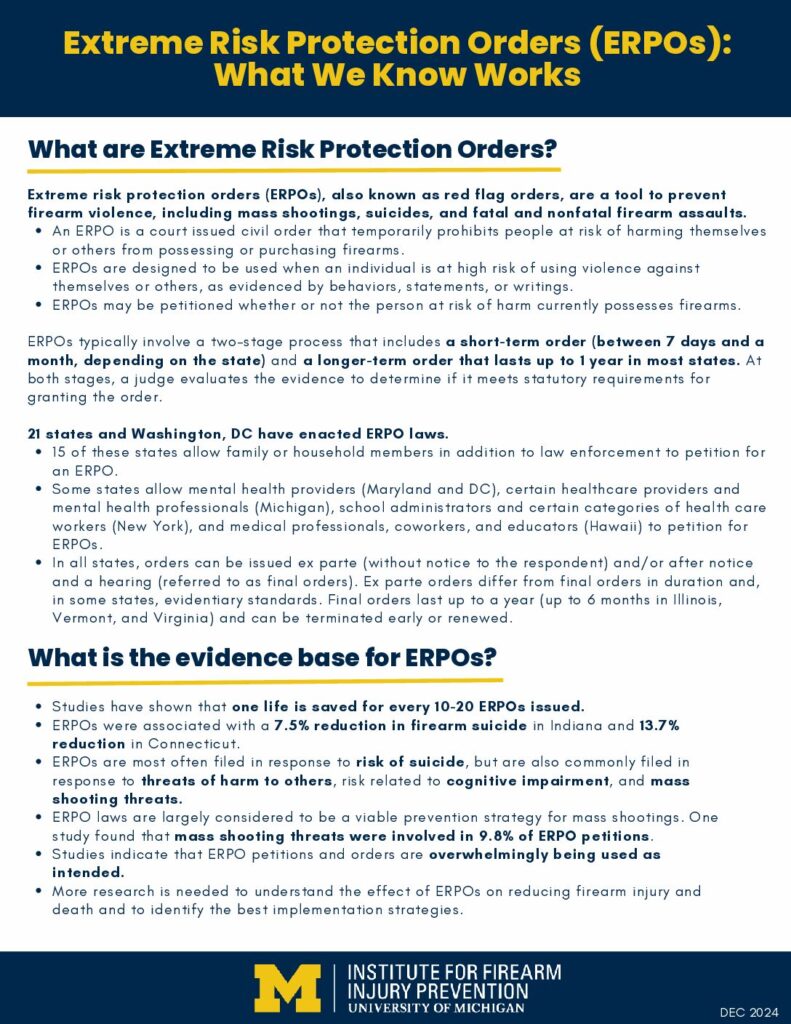
On February 13, 2024, Michigan enacted a “red flag law”, formally known as an Extreme Risk Protection Order (ERPO) law. ERPO laws authorize civil courts to temporarily restrict people at risk of harming themselves or others from possessing or purchasing firearms. In Michigan, law enforcement, families and household members, and healthcare providers can file an ERPO petition. In this section, learn more about Michigan’s ERPO law, who can file an ERPO petition, and what happens when an ERPO is filed in the Great Lakes State. If you are in immediate danger, call 911. If you are experiencing a crisis, call or text 988.
Learn More about Michigan’s Extreme Risk Protection Order
Filing an ERPO in Michigan
In Michigan, the Extreme Risk Protection Order (ERPO) law allows law enforcement, families and household members, and healthcare providers to file an ERPO petition. In this section, learn about the ERPO filing process in Michigan, from accessing and submitting court forms to the hearing process, as well as what options are available after an ERPO is ordered. If you are in immediate danger, call 911. If you are experiencing a crisis, call or text 988.
An ERPO petition in Michigan is called a complaint. The person filing an ERPO complaint, referred to as the petitioner, must fill out the relevant complaint forms and submit them to the family division of the circuit court. The complaint should describe the specific facts that show someone, known as the respondent, is at a significant risk of harming themselves or others. The respondent does not need to currently be in possession of a firearm for the petitioner to file an ERPO complaint.
If the petitioner believes the respondent is at risk of harming themselves or others in the very near future, the petitioner may indicate on the complaint form that they are requesting an ex parte order. An ex parte ERPO complaint will receive priority from the court to review, and will be decided without a hearing. If filing an ex parte complaint, the petitioner must detail why they feel an ex parte order is appropriate.
The petitioner must state, if known, whether there are currently any other legal actions, orders, or judgements, including another ERPO complaint or order, affecting the respondent. The petitioner must also state, if known, whether the respondent is a member of law enforcement or otherwise required to carry a firearm for their occupation.
The court will determine, based on the information detailed in the complaint and by the petitioner’s and respondent’s testimonies (if there is a hearing), whether an ERPO is necessary. The factors that the court may consider include, but are not limited to:
- Use of physical force or violence
- Prior or current legal injunctive orders
- ERPO or Personal Protection Order violations
- Criminal offences
- Alcohol or controlled substance abuse
- Unlawful use of deadly weapons or ammunition
- Serious mental illness or emotional disturbance
The following forms are used to begin the ERPO petition process:
If the respondent is an adult, use Form CC 452.
If the respondent is a minor, use Form CC 452m.
All complaints must include a Confidential Information Form, Form CC 450, which records the petitioner’s address. This form is kept confidential by the court. *Please note: this form only keeps the petitioner’s address confidential. Other information about the petitioner might not be kept confidential.
If the petitioner is a minor or legally incompetent/incapacitated, a Request for Next Friend and Order Form, Form CC 465, must be filled out. The Next Friend will take the responsibility of the complaint on behalf of the petitioner.
ERPO complaints must be filed to the family division of the circuit court. Circuit court jurisdictions are typically, but not always, along county borders.
- If the respondent is an adult, the petitioner can file the complaint in any county in Michigan, regardless of where the respondent or petitioner reside.
- If the respondent is a minor, the complaint must be filed in either the petitioner’s or the respondent’s county of residence.
- If the respondent does not reside in Michigan, the petitioner must file in their own county of residence.
If the ERPO petition does not indicate that an ex parte ERPO is requested, a hearing will be scheduled within 14 days for the court to determine if an ERPO is necessary. It is required for ERPO petitioners to attend a hearing with the court to review the complaint and the evidence for why an ERPO may be necessary. If the petitioner does not attend, the ERPO will be not be granted. When the petitioner requests a hearing (meaning they do not request an ex parte ERPO), the petitioner is responsible for providing a copy of the complaint and notice of the hearing to the respondent. If the respondent is a minor, the petitioner is responsible for serving the respondent’s parent(s) or legal guardian(s). The respondent is not required to attend the hearing. Both the petitioner and the respondent may have lawyers present, but this is not required. If requested, the court may allow the hearing to be conducted via videoconferencing.
If a complaint is filed ex parte, the court will decide on issuing the ERPO without a hearing. If an ex parte request is rejected by the court, the petitioner can still request a hearing within 21 days of the denial. That hearing would be scheduled within 14 days of the request. If an ex parte ERPO is ordered, the respondent will have the opportunity to request a hearing within 7 days of receiving the order, and the hearing will be scheduled within 14 days of the request.
*Please note: A hearing would be scheduled within 5 days if the respondent is a member of law enforcement or otherwise is required to carry a firearm for their occupation.
The court will decide whether to grant or deny an ERPO, based on the evidence, and will provide a written justification for their decision.
If an ERPO is granted, unless otherwise specified by the court, the petitioner is responsible for serving the order to the respondent and returning the proof of service document attached to the order back to the court. The respondent must turn in all of their firearms to law enforcement if they had any in their possession. If allowed by the court, the respondent may turn in their firearms to a licensed firearm dealer instead.
The court may specify that firearms must be turned in immediately, in which case a member of law enforcement will serve the ERPO to the respondent. In this case, the court may also grant an anticipatory search warrant to the law enforcement officer to search the respondent’s property for any firearms if the respondent refuses to comply with the order.
An ERPO in Michigan will last up to one year, during which the respondent is prohibited from possessing or purchasing firearms. If the respondent does not follow the order, they may face penalties such as fines or even jailtime. The petitioner may request to modify or rescind the ERPO at any point during the duration of the order. The respondent has the right to appeal to modify or end the order once per six month period of the order. At the end of the order, the petitioner or the court may motion to extend the order.
Petitioners and respondents may both use the Motion to Modify, Extend, or Terminate Order Form, Form CC 460, to request the court to change the ERPO. A hearing will be scheduled 14 days after the motion is submitted. Whoever submits the motion must notify the other party of the hearing.
When the ERPO ends, unless prohibited for another reason from possessing firearms, the court will order that the respondent will be allowed to possess and purchase firearms once again, and may reclaim any firearms turned into law enforcement or a licensed firearm dealer. The respondent has 90 days to reclaim any firearms; after 90 days, law enforcement may destroy the firearms if they are not reclaimed.
Please note: filing a complaint as a petitioner means you may be responsible for informing the respondent of the ERPO hearing as well as be responsible for serving the ERPO to the respondent. While petitioner addresses are kept confidential by the court, other personal information may not be. The petitioner’s identity will be known to the respondent.
If you are unsure, unable, or uncomfortable to serve as the petitioner, but still believe you need to file an ERPO complaint, contact your local law enforcement and request that they file an ERPO complaint on your behalf.
Not in Michigan?
see how to file an ERPO in your stateFrequently Asked Questions for Those Served an ERPO
If you’ve been served an extreme risk protection order (ERPO), you are considered the respondent to the order. Please read the service papers carefully and make sure you follow all of the instructions in the order. This section answers common questions surrounding being served an ERPO in Michigan, what steps need to be taken as the respondent, and what options are available for respondents.
ERPO laws authorize civil courts to temporarily prevent people at risk of harming themselves or others from possessing or purchasing firearms. In Michigan, the ERPO law allows law enforcement, families and household members, and healthcare providers to file an ERPO complaint.
An ERPO lasts for one year, but it may be extended one or more times by either the petitioner or the court, with each extension effective for one year after the expiration of the previous order. ERPOs can also be modified or terminated by the petitioner at any time. You will be given written notice if a hearing is scheduled on whether the ERPO might be extended, modified, or terminated. You can also ask the court to end the ERPO early through filing a Motion to Modify, Terminate, or Extend the ERPO, Form CC 460.
If the court issues an ERPO ex parte (without a hearing that you had the opportunity to attend), you will have to comply with the order. You have the right to request a hearing within 7 days of being served, and the hearing will be held no later than 14 days after you receive notice of or are served with the ERPO. If your job requires you to carry a pistol, you can request a hearing to be held no later than 5 days after you receive notice of or are served with the ERPO.
If you were served an ERPO ex parte, you have the right to request a hearing. If a hearing has been requested by the person who petitioned for the ERPO, you will receive notice of a hearing in which the court will decide whether to grant or deny the ERPO, to be held within 14 days of the petition (complaint) being filed. You will have the opportunity to be heard at the hearing if you would like to present any concerns or objections that you have about the order. If you request a hearing, you must attend for your case to be heard. Although not required, you have the right to seek the advice of an attorney.
Please read the service papers carefully and make sure you follow all of the instructions in the order. If you are served with an ERPO, you will need to turn in any firearms you own to the law enforcement or, if allowed by the court, to a licensed firearm dealer. If you have a concealed pistol license, you must turn it in to the county clerk. You must file with the court any documents or other evidence verifying that you turned in all the firearms that you own and your concealed pistol license, if applicable. If you do not own any firearms, you must file documents or evidence verifying that, instead. For the duration of the order, you will not be able to obtain any new firearms.
If you don’t follow the instructions of the service papers, the court clerk will inform the local law enforcement agency, which will try to determine if you have held onto any firearms or a concealed pistol license. The court will schedule a compliance hearing to be held no later than 5 days after the ERPO is served, which can be canceled if you submit the required documentation before the hearing. If you neither submit the required documentation nor appear at the compliance hearing, the court will issue a bench warrant and a search warrant to seize any firearms, and you may be held in contempt. It is a felony offense not to comply with an ERPO, punishable by prison time and/or a fine.
Yes. You can file a motion to modify or end the order and request a hearing once during the first six months that the order is in effect and once during the second six months. At the hearing, you can provide evidence for why the ERPO is no longer necessary.
When the ERPO ends, unless prohibited for another reason from possessing firearms, the court will order that you will be allowed to possess and purchase firearms once again, and may reclaim any firearms turned into law enforcement or a licensed firearm dealer. You will have 90 days to reclaim any firearms turned in to law enforcement; after 90 days, law enforcement may destroy the firearms if they are not reclaimed.
ERPO case files are public record. This may include phone and email information of the parties listed in the record. However, ERPO case files do not disclose the petitioner’s address and courts are discouraged by the Michigan State Court Administrative Office from publishing case information online.

What is Secure Storage?
Secure firearm storage involves storing firearms unloaded, separate from ammunition and locked through various methods. It is an important practice that reduces the risk of firearm-related injuries. When both firearms and ammunition are stored securely, children have a 78% lower risk of self-inflicted firearm injuries and an 85% lower risk of unintentional firearm injuries. One study estimated that if half of households with unlocked guns switched to locking them, one third of youth gun suicides and unintentional deaths could be prevented. Secure firearm storage leads to reductions in intentional and unintentional firearm-related injuries and deaths among children and others, and lower rates of firearm theft.
Secure Storage Methods
A variety of devices can be used to store firearms securely, reducing unauthorized access. The most appropriate method varies based on the storage circumstances. In all cases, firearms should be unloaded and stored separately from ammunition. The information below provides descriptions, effects, and strengths of different secure storage methods.

Cable Lock
Cable Locks
Cable locks are widely available and can be used on most firearms. Cable locks can be inserted through the barrel, action, or magazine well of a firearm to prevent firing, requiring a key or combination to be removed. Allows for easy access and reduces the likelihood of theft, but can generally be dismantled relatively easily, reducing effectiveness with older children and adults.
Price Range: $10 – $50

Trigger Lock
Trigger Locks
Locks the trigger of a firearm. Ammunition needs to be removed. Allows for easy access and reduces the likelihood of theft, but can generally be dismantled relatively easily, reducing effectiveness with older children and adults.
Price Range: $10 – $75

Lock Box
Lock Boxes and Gun Cases
Lock boxes and gun cases are smaller and more portable than gun safes, yet still prevent access by children and unauthorized users by locking a firearm in a secure container. Lock boxes typically come with integrated locks which can be manual or biometric, but gun cases may need an external lock such as a padlock to ensure security.
Price Range: $25 – $300

Gun Safe
Gun Safes and Cabinets
Gun safes or cabinets allow for storage of multiple weapons, preventing access by unauthorized users, including children, and theft. Safes and cabinets are sturdy and offer some of the most secure storage options for firearms. Locks can be manual via key or combination or use biometric data. While not typically easily transportable, safes and cabinets come in a variety of shapes and sizes, and can be placed anywhere in the home that the firearm owner chooses. Specially made safes are also available for vehicle storage.
Price Range: $100 – $2000+

Out-of-Home Storage
Out-of-Home Storage
Out-of-home storage can be the most effective and appropriate method of secure storage in certain cases. Firearm storage may be available at business storage lockers, self-storage rental units, existing armories, and pawn shops. Specific requirements, processes, and prices of storage in these locations can vary by state and individual location.
Disassembling firearms is the most secure way to reduce the risk of firearm injury.
Firearm disassembly can be paired with all of the above secure storage methods. Disassembling the firearm into component parts, along with the removal of key elements, will prevent quick unauthorized use. Solely disassembling a firearm is not an exemption to the secure storage law.
Secure Storage in the Home
Firearm-related injuries and deaths are a public health crisis, especially for children and teens. Children and teens are a high risk group for unintentional firearm injury and death as well as firearm suicide, and more than 4 and a half million children live in a household with an insecurely stored firearm. In this section, find resources for parents and other family members for best firearm storage practices. This section provides resources for family and household members for best firearm storage practices.
The facts:
Over one-third of adolescents in a firearm-owning household report being able to access a loaded firearm within 5 minutes.
When both firearms and ammunition are stored safely, children have a 78% lower risk of self-inflicted firearm injuries and an 85% lower risk of unintentional firearm injuries.
One study estimated that if half of households with unlocked guns switched to locking them, one third of youth gun suicides and unintentional deaths could be prevented.
Around 75% of perpetrators of school shootings obtained their firearm from their home or the home of a close relative.
- Over one-third of adolescents in a firearm-owning household report being able to access a loaded firearm within 5 minutes.
- When both firearms and ammunition are stored safely, children have a 78% lower risk of self-inflicted firearm injuries and an 85% lower risk of unintentional firearm injuries.
- One study estimated that if half of households with unlocked guns switched to locking them, one third of youth gun suicides and unintentional deaths could be prevented.
- Around 75% of perpetrators of school shootings obtained their firearm from their home or the home of a close relative.
Resources for Families
Conversation Starters about Firearm Safety
It is important that families and caregivers have conversations with other households about firearm ownership and storage practices before a child enters the home. The resources listed can be shared with caregivers and offer guidance on initiating and maintaining those conversations.
Resources
Why and How You Should Ask Other Parents if They Own Guns
This article from John Hopkins School of Public Health offers guidance on starting conversations with other caregivers about the presence and storage of firearms in the home. The article provides tips on making these conversations more comfortable and approachable while still ensuring the safety and comfort of children when they enter another home.
This guide explains the importance of asking family, friends, and other community members about their firearm storage. Caregivers and other community members can also find tips on how to ask the questions that help keep kids safe.
Talking to Your Children About Guns
This resource from the Be SMART Program offers suggestions on how to talk to young children and adolescents about firearm safety, explains the risk of unintentional firearm injury in children, and stresses the importance of secure firearm storage.
Crisis Help Resources
If you or someone you love is experiencing a crisis, there are resources available to help. In this section learn about local Michigan crisis support resources, both statewide and county-specific, as well as some nationwide crisis resources. See a more comprehensive list of nationwide resources.
If you are in immediate danger, please call 911.
If you are experiencing a suicidal crisis or emotional distress, please text or call 988.
MDHHS Suicide Coalitions and Crisis Lines
The Michigan Dept. of Health and Human Services provides a comprehensive list of suicide prevention coalitions and crisis lines across the Great Lakes State. In this resource, find a list of county-specific resources available for those in crisis and their loved ones.
Michigan Sexual Assault Hotline
Michigan’s Sexual Assault Hotline is a confidential, anonymous, 24/7 hotline to help sexual assault survivors and their loved ones. The Hotline has trained advocates available to provide support, crisis counseling, and referrals to local service providers. Call 1-855-864-2374 or text 1-866-238-1454 to get in contact.
Michigan Coalition to End Domestic and Sexual Violence
The Michigan Coalition to End Domestic and Sexual Violence is dedicated to empowering survivors of sexual violence, domestic violence, and human trafficking in Michigan. To get in contact with advocates, call 855-VOICES4 for survivors of sexual assault, and call 866-VOICEDV for survivors of domestic violence.
Michigan Crisis and Access Line (MiCAL)
The Michigan Crisis and Access Line (MiCAL) is the statewide crisis and access line. MiCAL is a 988 call center and is primarily responsible for answering 988 calls originating from Michigan. Text or call 988 to receive 24/7, free and confidential support for people in distress as well as prevention and crisis resources.
Veterans Crisis Line
Call 988 and then press 1, or text 838255, to receive 24/7 crisis support specifically for veterans and their loved ones. You do not need to be enrolled in VA benefits or healthcare to utilize this service.