
Healthcare Providers
Healthcare providers are often the first interaction someone at-risk of harming themselves or others has where an opportunity for harm reduction and prevention can be offered. As petitioners, Extreme Risk Protection Orders are a vital tool in the toolbox healthcare providers can use in responding to critical patient needs.
Healthcare providers can also promote secure firearm storage in a number of ways. Healthcare professionals can counsel patients and their families on access to lethal means, screen patients for firearm injury risk, as well as provide information and materials on secure firearm storage methods. Learn more about the role healthcare professionals can play from the resources below.
ERPO for Healthcare Providers
The Clinical Scenarios listed here, created by the BulletPoints Project, a firearm injury prevention program funded by the State of California, provide thorough guides for working with patients at risk of committing harm with firearms–including when to know if an ERPO may be necessary for a patient in crisis. Please note that BulletPoints is based in California, and may cite or link to resources that are not available or applicable outside of that state. Learn more about the BulletPoints Project and its mission here.
3 / Unintentional Firearm Injury
4 / Intimate Partner Violence and Firearms
7 / Community Firearm Violence
For clinician-focused educational materials on ERPOs, including clinical scenarios, firearm violence risk screening questions, and more, review the Clinicians page of this toolkit.
Healthcare providers must uphold the HIPAA privacy rule and patient-doctor confidentiality when filing an ERPO petition. The US Department of Health and Human Services (DHHS) has provided guidelines to navigate disclosing protected health information (PHI) as part of an ERPO petition. Learn more about ERPOs, patient privacy, and PHI disclosures from the guidelines here.
- Letter from DHHS on disclosing PHI when a patient presents serious danger to themselves or others
- HIPAA Privacy Rule and Disclosures of Protected Health Information for Extreme Risk Protection Orders
- HIPAA Privacy Rule and Sharing Information Related to Mental Health
- When does the Privacy Rule allow covered entities to disclose protected health information to law enforcement officials?
- What constitutes a “serious and imminent” threat that would permit a health care provider to disclose PHI to prevent harm to the patient, another person, or the public without the patient’s authorization or permission?
For clinician-focused educational materials on ERPOs, including clinical scenarios, firearm violence risk screening questions, and more, review the Clinicians page of the Extreme Risk Protection Order Toolkit.
If your organization is interested in receiving free training and technical assistance regarding ERPOs, how to use them, or educating your staff about them, submit a training request form.
Request TEchnical Assistance
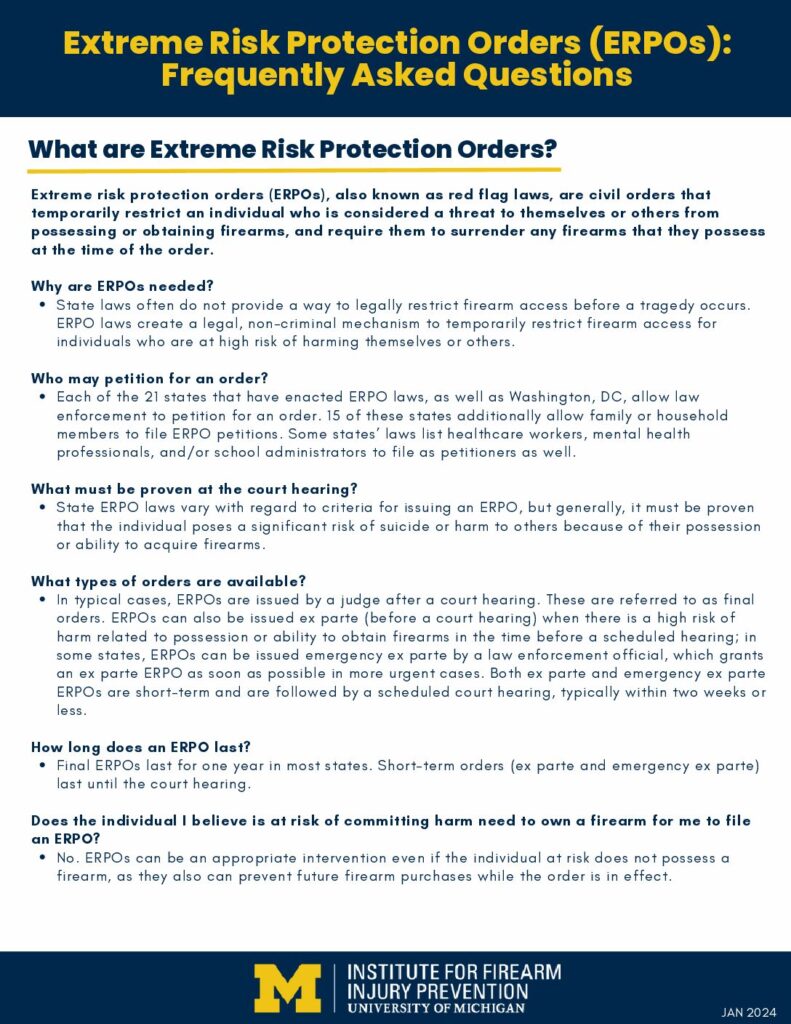
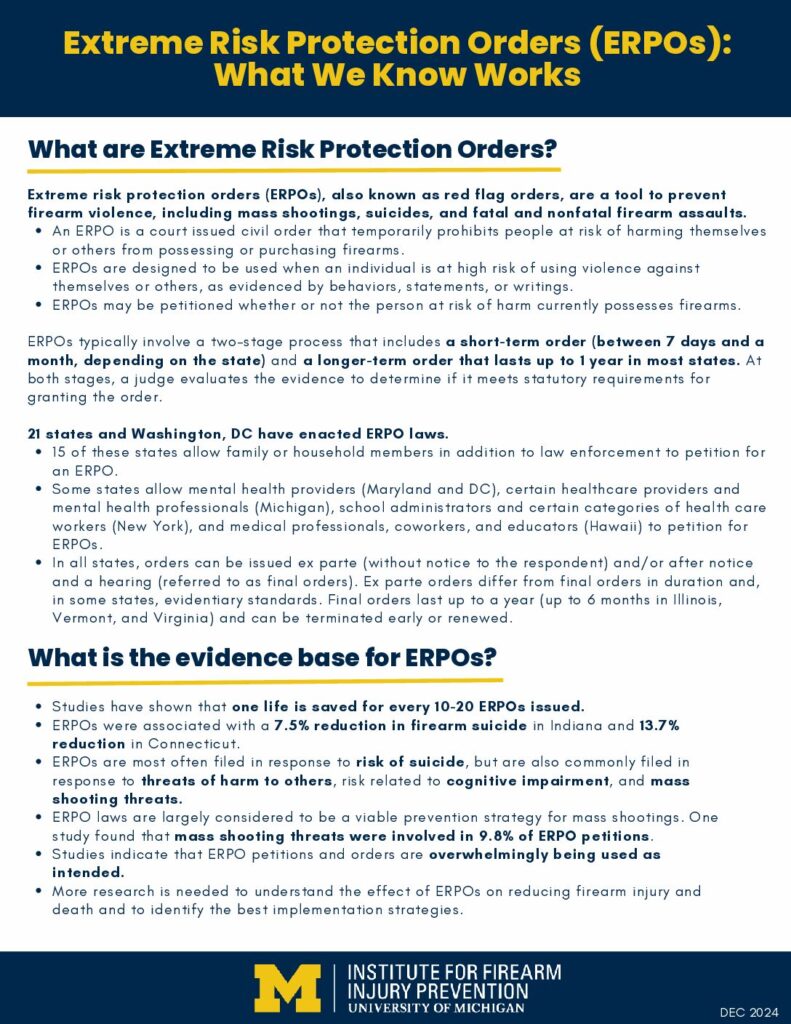
What is an ERPO?

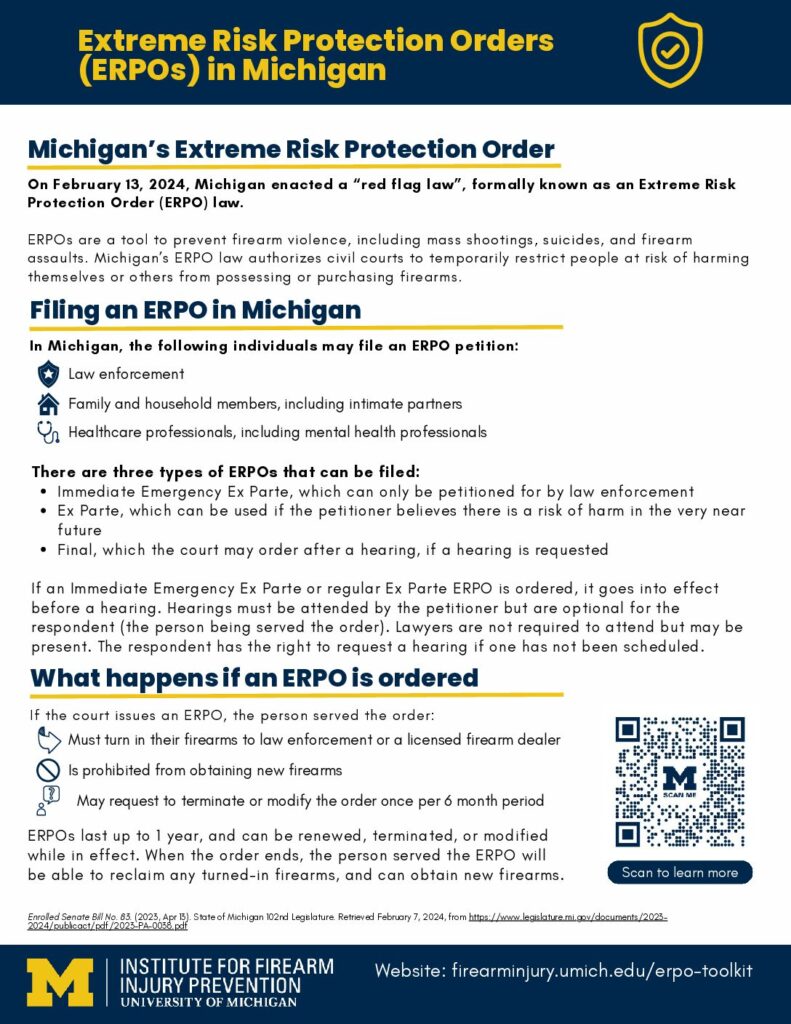
On February 13, 2024, Michigan enacted a “red flag law”, formally known as an Extreme Risk Protection Order (ERPO) law. ERPO laws authorize civil courts to temporarily restrict people at risk of harming themselves or others from possessing or purchasing firearms. In Michigan, law enforcement, families and household members, and healthcare providers can file an ERPO petition. In this section, learn more about Michigan’s ERPO law, who can file an ERPO petition, and what happens when an ERPO is filed in the Great Lakes State. If you are in immediate danger, call 911. If you are experiencing a crisis, call or text 988.
Learn More about Michigan’s Extreme Risk Protection Order
Filing an ERPO in Michigan
In Michigan, the Extreme Risk Protection Order (ERPO) law allows law enforcement, families and household members, and healthcare providers to file an ERPO petition. In this section, learn about the ERPO filing process in Michigan, from accessing and submitting court forms to the hearing process, as well as what options are available after an ERPO is ordered. If you are in immediate danger, call 911. If you are experiencing a crisis, call or text 988.
An ERPO petition in Michigan is called a complaint. The person filing an ERPO complaint, referred to as the petitioner, must fill out the relevant complaint forms and submit them to the family division of the circuit court. The complaint should describe the specific facts that show someone, known as the respondent, is at a significant risk of harming themselves or others. The respondent does not need to currently be in possession of a firearm for the petitioner to file an ERPO complaint.
If the petitioner believes the respondent is at risk of harming themselves or others in the very near future, the petitioner may indicate on the complaint form that they are requesting an ex parte order. An ex parte ERPO complaint will receive priority from the court to review, and will be decided without a hearing. If filing an ex parte complaint, the petitioner must detail why they feel an ex parte order is appropriate.
The petitioner must state, if known, whether there are currently any other legal actions, orders, or judgements, including another ERPO complaint or order, affecting the respondent. The petitioner must also state, if known, whether the respondent is a member of law enforcement or otherwise required to carry a firearm for their occupation.
The court will determine, based on the information detailed in the complaint and by the petitioner’s and respondent’s testimonies (if there is a hearing), whether an ERPO is necessary. The factors that the court may consider include, but are not limited to:
- Use of physical force or violence
- Prior or current legal injunctive orders
- ERPO or Personal Protection Order violations
- Criminal offences
- Alcohol or controlled substance abuse
- Unlawful use of deadly weapons or ammunition
- Serious mental illness or emotional disturbance
The following forms are used to begin the ERPO petition process:
If the respondent is an adult, use Form CC 452.
If the respondent is a minor, use Form CC 452m.
All complaints must include a Confidential Information Form, Form CC 450, which records the petitioner’s address. This form is kept confidential by the court. *Please note: this form only keeps the petitioner’s address confidential. Other information about the petitioner might not be kept confidential.
If the petitioner is a minor or legally incompetent/incapacitated, a Request for Next Friend and Order Form, Form CC 465, must be filled out. The Next Friend will take the responsibility of the complaint on behalf of the petitioner.
ERPO complaints must be filed to the family division of the circuit court. Circuit court jurisdictions are typically, but not always, along county borders.
- If the respondent is an adult, the petitioner can file the complaint in any county in Michigan, regardless of where the respondent or petitioner reside.
- If the respondent is a minor, the complaint must be filed in either the petitioner’s or the respondent’s county of residence.
- If the respondent does not reside in Michigan, the petitioner must file in their own county of residence.
If the ERPO petition does not indicate that an ex parte ERPO is requested, a hearing will be scheduled within 14 days for the court to determine if an ERPO is necessary. It is required for ERPO petitioners to attend a hearing with the court to review the complaint and the evidence for why an ERPO may be necessary. If the petitioner does not attend, the ERPO will be not be granted. When the petitioner requests a hearing (meaning they do not request an ex parte ERPO), the petitioner is responsible for providing a copy of the complaint and notice of the hearing to the respondent. If the respondent is a minor, the petitioner is responsible for serving the respondent’s parent(s) or legal guardian(s). The respondent is not required to attend the hearing. Both the petitioner and the respondent may have lawyers present, but this is not required. If requested, the court may allow the hearing to be conducted via videoconferencing.
If a complaint is filed ex parte, the court will decide on issuing the ERPO without a hearing. If an ex parte request is rejected by the court, the petitioner can still request a hearing within 21 days of the denial. That hearing would be scheduled within 14 days of the request. If an ex parte ERPO is ordered, the respondent will have the opportunity to request a hearing within 7 days of receiving the order, and the hearing will be scheduled within 14 days of the request.
*Please note: A hearing would be scheduled within 5 days if the respondent is a member of law enforcement or otherwise is required to carry a firearm for their occupation.
The court will decide whether to grant or deny an ERPO, based on the evidence, and will provide a written justification for their decision.
If an ERPO is granted, unless otherwise specified by the court, the petitioner is responsible for serving the order to the respondent and returning the proof of service document attached to the order back to the court. The respondent must turn in all of their firearms to law enforcement if they had any in their possession. If allowed by the court, the respondent may turn in their firearms to a licensed firearm dealer instead.
The court may specify that firearms must be turned in immediately, in which case a member of law enforcement will serve the ERPO to the respondent. In this case, the court may also grant an anticipatory search warrant to the law enforcement officer to search the respondent’s property for any firearms if the respondent refuses to comply with the order.
An ERPO in Michigan will last up to one year, during which the respondent is prohibited from possessing or purchasing firearms. If the respondent does not follow the order, they may face penalties such as fines or even jailtime. The petitioner may request to modify or rescind the ERPO at any point during the duration of the order. The respondent has the right to appeal to modify or end the order once per six month period of the order. At the end of the order, the petitioner or the court may motion to extend the order.
Petitioners and respondents may both use the Motion to Modify, Extend, or Terminate Order Form, Form CC 460, to request the court to change the ERPO. A hearing will be scheduled 14 days after the motion is submitted. Whoever submits the motion must notify the other party of the hearing.
When the ERPO ends, unless prohibited for another reason from possessing firearms, the court will order that the respondent will be allowed to possess and purchase firearms once again, and may reclaim any firearms turned into law enforcement or a licensed firearm dealer. The respondent has 90 days to reclaim any firearms; after 90 days, law enforcement may destroy the firearms if they are not reclaimed.
Please note: filing a complaint as a petitioner means you may be responsible for informing the respondent of the ERPO hearing as well as be responsible for serving the ERPO to the respondent. While petitioner addresses are kept confidential by the court, other personal information may not be. The petitioner’s identity will be known to the respondent.
If you are unsure, unable, or uncomfortable to serve as the petitioner, but still believe you need to file an ERPO complaint, contact your local law enforcement and request that they file an ERPO complaint on your behalf.
Not in Michigan?
see how to file an ERPO in your state
What is Secure Storage?
Secure firearm storage involves storing firearms unloaded, separate from ammunition and locked through various methods. It is an important practice that reduces the risk of firearm-related injuries. When both firearms and ammunition are stored securely, children have a 78% lower risk of self-inflicted firearm injuries and an 85% lower risk of unintentional firearm injuries. One study estimated that if half of households with unlocked guns switched to locking them, one third of youth gun suicides and unintentional deaths could be prevented. Secure firearm storage leads to reductions in intentional and unintentional firearm-related injuries and deaths among children and others, and lower rates of firearm theft.
Lethal Means Counseling
Lethal means counseling is a suicide prevention method that involves reducing or preventing access to the most lethal methods of suicide attempt, which can profoundly reduce the risk of an individual in crisis committing harm to themselves or others. Lethal means counseling can also be important in reducing the risk of unintentional injury, especially among children. Extreme Risk Protection Orders are legal interventions for individuals in crisis who present an immediate risk for committing firearm violence. However, there are other methods clinicians can use to reduce the risk of firearm violence for patients who may be at risk. Learn more about lethal means counseling from the resources below.
- Suicide Prevention Resource Center Counseling on Access to Lethal Means (CALM)
- Harvard Injury Research Center: Means Matters
- Univ. of Colorado (Boulder) Lock-to-Live Patient Decision Aid (PDA) to Facilitate LMSC Discussions
- Veterans’ Health Administration “Keep It Locked” Materials
- Harborview Injury Center Voluntary Waiver of Firearm Rights
Clinicians are uniquely poised to assist patients and their families.
Nearly half of those who die by suicide are seen by a health care provider in the weeks preceding their death.
Clinicians are empowered to identify high-risk patients with access to firearms and have the tools to counsel patients and their families on safely storing firearms.
Firearms are the most lethal means for attempting suicide.
According to research conducted by the Center for Disease Control, 55% of suicides are by firearm.
Firearm suicide has the highest mortality rate among suicide mechanisms, as nearly 90% of firearm suicide attempts are fatal.
Firearm suicide is a leading mechanism for suicide among high-risk groups.
Suicide is the second leading cause of death among Americans aged 10-34, behind only unintentional injuries and accidents.
Suicide among older adults is increasing in the United States, and firearms are the leading mechanism for suicide among older men.
Among veterans, one of the most at-risk groups for suicide, 71% of suicides are by firearm.
Improper firearm storage is a leading cause of unintentional firearm injury and death.
In cases of unintentional firearm death, children are the most at-risk group.
A leading reason for unintentional firearm injury and death is the victim believing the firearm was stored unloaded when it was not.
When both firearms and ammunition are stored securely, children have a 78% lower risk of self-inflicted firearm injuries and an 85% lower risk of unintentional firearm injuries.
Firearm Risk Screening
Clinicians routinely ask patients about everyday habits and lifestyle choices, such as diet, exercise, alcohol and tobacco consumption, sexual activity, and more, to ensure the health and safety of patients and their loved ones. With gun violence increasingly identified as a public health crisis, and with firearm-related suicide as the leading cause of suicide deaths in the United States, it is important for clinicians to engage their patients about access to firearms, and screen their patients for firearm injury risk.

In this section, learn methods for screening patients for firearm violence and injury risk in a variety of contexts, including for suicide, homicide, and domestic violence risk.